How Much Should a Small Business Spend on Google Ads?
Plan Your Advertising Budget Around Customer Value, Qualified Leads and Sustainable Growth
A small business Google Ads budget should reflect customer value, affordable acquisition costs, likely click costs and available demand. There is no single monthly amount that suits every business.
Instead of starting with an arbitrary figure such as £500 or £1,000 per month, a sensible Google Ads budget should reflect what a customer is worth to your business, what you can afford to pay to acquire one, how much relevant clicks are likely to cost and how much search demand exists.
For some small businesses, £500 per month could provide enough traffic to begin generating useful data and enquiries. In a highly competitive market where clicks are expensive, the same budget could be too restrictive.
The objective isn’t to find the lowest possible budget.
It’s to find a budget that gives Google Ads a realistic opportunity to generate commercially worthwhile results.
What You’ll Learn in this Guide:
By the end of this guide, you’ll understand:
- How to work backwards from customer value to a sensible budget
- How click costs and enquiry rates affect the numbers
- What Colne Digital sees in real small-business accounts
- Why advertising spend and management fees should be assessed separately
- When to focus, test or increase your budget
Reading Time:
10–13 Minute Read
Last Updated:
October 2026
Author:
Mark Finlay | Colne Digital
Start With What a New Customer Is Worth
Before deciding how much to spend on Google Ads, establish what acquiring a customer is actually worth.
Suppose an average customer generates £2,000 in revenue.
That doesn’t mean you can afford to spend £2,000 acquiring them. You still need to account for labour, products or materials, overheads and the profit the business needs to make.
In this hypothetical model, suppose the business can allocate £300 in advertising spend to acquiring a customer after allowing for management fees and its other costs.
We now know considerably more than we would from simply deciding:
“Let’s try £1,000 per month.”
We know the advertising needs to contribute towards acquiring customers at around £300 or less for the numbers to work as intended.
Work Backwards From Customers to Enquiries
For many small service businesses, a Google Ads conversion is an enquiry rather than a completed sale. If you are new to the platform, start with our guide to what Google Ads are and how they work.
Not every enquiry becomes a customer.
Suppose approximately one in four qualified enquiries turns into a customer.
That’s a 25% lead-to-customer rate.
If you can afford to spend £300 acquiring a customer, your approximate target cost per qualified enquiry would be:
£300 × 25% = £75
Now we have a useful commercial target.
If Google Ads consistently generates qualified enquiries for £50, there may be room to increase investment.
If qualified enquiries cost £200, something needs to change for the campaign economics to work.
The important word here is qualified.
Ten irrelevant enquiries at £30 each aren’t necessarily better than five genuine opportunities at £60 each.
Consider How Much Relevant Clicks Cost
Next, you need some idea of how much it may cost to attract potential customers.
Google Ads costs vary substantially depending on factors such as industry, keywords, competition and location. Google’s Keyword Planner provides keyword, search-volume and cost estimates for planning. Estimates are a starting point rather than a promise of results.
Those estimates should reflect the services and locations you actually want to target.
You can then build a simple model.
Suppose relevant traffic is expected to cost approximately £5 per click and you have a £1,000 monthly budget:
£1,000 ÷ £5 = approximately 200 clicks
If 5% of those visitors became enquiries:
200 × 5% = approximately 10 enquiries
That would give an illustrative advertising cost per enquiry of:
£1,000 ÷ 10 = £100
These figures aren’t a prediction. This hypothetical £100 cost per enquiry is above the £75 target calculated earlier. It would imply around £400 in advertising spend per customer at a 25% enquiry-to-customer rate, so the assumptions would need to improve for the £300 advertising target to be met. The model also assumes the enquiries are qualified; if some are unsuitable, the economics are weaker.
Actual CPCs and conversion rates will vary. Modelling the numbers before launch helps identify which assumptions would need to hold for the budget to make commercial sense.
For a fuller explanation of CPC and advertising costs, read our guide to how much Google Ads costs in the UK.
What We See in Real Small-Business Accounts
One of our clients, a double glazing company targeting Essex, runs around four to five product campaigns at a time, using a mixture of Search and Performance Max. At around £500 per campaign per month in advertising spend, the account is generating valuable, high-intent leads. That is roughly £2,000–£2,500 across those campaigns, excluding management fees.
We also work with service businesses such as plumbers and electricians that can allocate around £300 per campaign per month. Focused targeting, continuous optimisation and excluding unsuitable searches have helped those accounts attract high-intent enquiries. Competition can still make individual leads expensive; a modest budget does not guarantee a low cost per lead.
For local trades, geographically targeted Google Search campaigns and Local Services Ads are different products. Either may have a role where suitable, but their costs and lead handling should be assessed separately. A campaign budget should be planned for the advertising product actually being used.
At the other end of the range, we work with retail clients investing more than £10,000 per campaign per month through activity including Shopping and remarketing. Their scale does not make that a suitable starting point for a small service business.
These are observations from individual accounts, not recommended minimums or forecasts for another advertiser. We recommend budgets after industry and business research, followed by campaign testing. Client feedback on whether enquiries become genuine opportunities is part of that assessment.
Can Your Google Ads Budget Be Too Small?
Yes, depending on the market.
Imagine relevant clicks cost approximately £10 and your monthly budget is £200.
At that hypothetical CPC:
£200 ÷ £10 = approximately 20 clicks per month
If your website converted 5% of those visitors, that’s approximately one enquiry.
With such a small amount of activity, a single conversion – or lack of one – can dramatically change how the month’s performance appears.
This doesn’t mean every business needs a large Google Ads budget.
It means your budget needs to be large enough relative to the market you’re entering to give the campaign a reasonable opportunity to generate useful traffic and results.
Can Your Google Ads Budget Be Too Large?
Yes.
A bigger budget doesn’t automatically produce proportionately more customers.
Search demand is finite.
If you’re already capturing a substantial amount of the relevant demand available for your services and location, increasing the budget doesn’t cause more people to search for what you sell.
Additional spend may require expansion into other keywords, services, locations or campaign types.
That could be profitable, but it shouldn’t be assumed.
We’d rather increase a small business’s Google Ads budget because the evidence suggests additional profitable demand is available, not simply because Google says the campaign is budget-limited.
Should You Start With £500, £1,000 or £2,000 Per Month?
There is no universal answer, but you can use some simple questions to assess a proposed starting budget.
- How many relevant clicks is the budget likely to purchase?
- How many of those visitors would need to enquire?
- How many enquiries would need to become customers?
- What would the resulting acquisition cost be?
- Would that be commercially viable for your business?
For example, if your expected CPC is around £5:
£500 could theoretically purchase around 100 clicks.
£1,000 could theoretically purchase around 200 clicks.
£2,000 could theoretically purchase around 400 clicks.
But those numbers tell us nothing about profitability until we know what happens after the click.
That’s why we wouldn’t recommend a particular starting budget solely on the basis that a business is “small”.
Don’t Spread a Small Budget Too Thinly
Another common consideration is how much you’re asking the budget to cover.
Imagine a business has £1,000 per month but wants to advertise five services across several locations using multiple campaigns.
Dividing the available budget too widely can leave individual campaigns with very little opportunity to generate traffic and conversion data.
A more focused starting strategy can sometimes make more sense.
That might mean prioritising the services with the strongest commercial value and relevant search demand before expanding once the business has evidence about what’s working.
More campaigns don’t automatically mean more results.
When Should You Increase Your Google Ads Budget?
Increasing your budget can make sense when the existing campaign is producing commercially worthwhile results and there is evidence that additional profitable demand is available.
Before increasing spend, we’d want to understand:
- Are the enquiries genuinely valuable?
- Are they becoming customers?
- Is the acquisition cost commercially acceptable?
- Is the campaign missing relevant opportunities because of budget?
- Can the business handle additional enquiries or customers?
If the answers are positive, increasing investment may be justified.
If the campaign isn’t generating the right customers at its current budget, adding more money isn’t necessarily the solution.
The Colne Digital Approach to a Small Business Google Ads Budget
At Colne Digital, we don’t believe a small business should spend a particular amount on Google Ads simply because of its turnover, number of employees or what another company spends.
We prefer to work backwards.
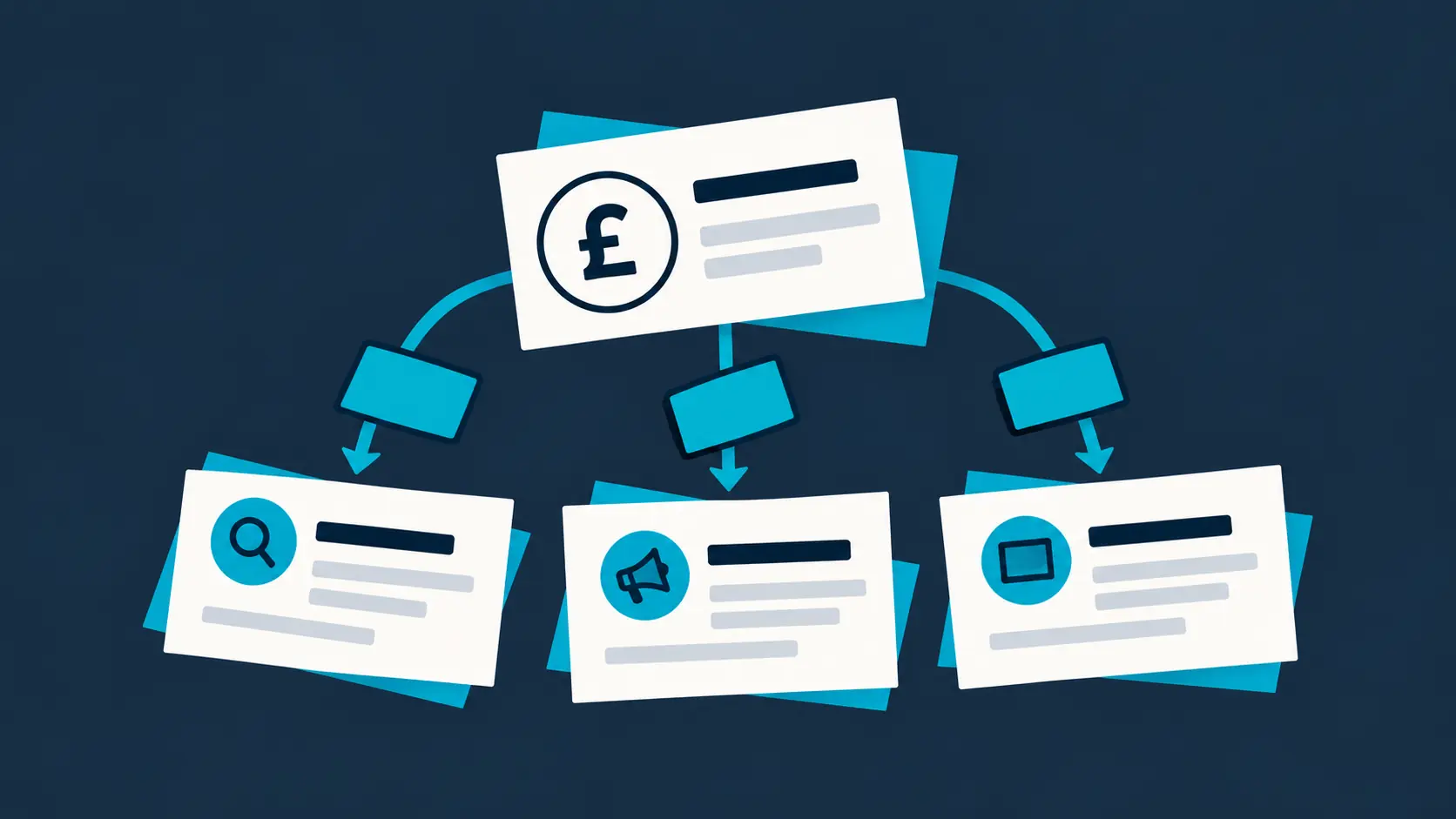
Customer value ? acceptable acquisition cost ? qualified lead value ? expected traffic costs ? available search demand ? budget.
That gives the budget a commercial rationale.
Once campaigns are running, real performance data can replace some of the assumptions used during initial planning.
And as we learn which searches, services and campaigns produce genuine customers, the budget can be adjusted accordingly.
The objective isn’t to spend the entire budget at any cost.
It’s to put the available budget where it has the strongest opportunity to produce profitable business.

A Practical Budget Check
Before increasing spend, compare the number of qualified enquiries you can realistically handle with the amount of relevant search demand available. If the campaign already captures most eligible demand, a larger budget may not translate into proportionately more customers. If leads are arriving but few become customers, review quality and follow-up before simply spending more.
Final Thoughts
Enough to give the campaign a realistic opportunity to generate meaningful data and customers, but not more than the economics of the business can justify.
Start with what a customer is worth.
Work backwards to what you can afford to pay for a qualified enquiry.
Estimate the cost and volume of relevant traffic.
Then use actual campaign and customer data to refine the budget once advertising begins.
That’s a much stronger foundation than choosing £500, £1,000 or £2,000 simply because it sounds like the right amount.
If you are unsure what budget makes sense, our Google Ads management service can help assess your market, search demand and likely costs before agreeing priorities.
Ready to Take the Next Step?
If you’re considering Google Ads for your business or would like expert guidance on improving an existing account, our team is here to help.
At Colne Digital, we specialise exclusively in Google Ads management, helping businesses generate more qualified leads, increase sales and maximise return on investment through transparent, data-driven campaign management.
Frequently Asked Questions About Small Business Budgets
Answers to your questions about starting budgets, testing and customer value.
Use these answers alongside your own campaign data and business objectives when deciding what to do next.
It can be. Whether £500 is sufficient depends on the cost of relevant clicks, search demand, conversion rate and customer value. In an expensive market, £500 may provide too little traffic to generate meaningful results consistently.
£1,000 may be appropriate for some businesses and completely unsuitable for others. Estimate how much relevant traffic it could purchase and what conversion rate would be required for the numbers to work commercially.
We wouldn’t recommend setting a Google Ads budget purely as a fixed percentage of revenue. Customer value, margins, acquisition costs, search demand and growth objectives provide more useful information when deciding what the business can afford to invest.
Not automatically. First establish whether the campaign is producing valuable enquiries or customers at an acceptable cost. Being able to spend more doesn’t necessarily mean additional spend will be profitable.
Set a testing period around the campaign’s learning, traffic volume, conversion cycle and customer feedback. Colne Digital monitors new campaigns daily while avoiding excessive substantial changes. Low-volume accounts may need longer to provide useful evidence.

Author: Mark Finlay, Founder of Colne Digital. We specialise in Google Ads management for UK businesses. This guide explains the fundamentals and links to Google’s documentation for technical details. Every article in our Knowledge Base is written to provide clear, practical and up-to-date advice based on real-world Google Ads experience.